

Friday, April 29, 2016


Sunday, April 24, 2016
Inside the abandoned underground Communist airbase nestling on the Croatian-Bosnian border

Read more: http://www.dailymail.co.uk/news/article-3081040/Rusting-planes-surrounded-minefield-radioactive-dust-Inside-abandoned-underground-Communist-airbase-nestling-Croatian-Bosnian-border.html#ixzz46kwBM51X Follow us: @MailOnline on Twitter | DailyMail on Facebook
Wednesday, April 13, 2016
Sunday, April 10, 2016
Thursday, April 07, 2016
Monday, April 04, 2016
Sunday, April 03, 2016
Wednesday, March 23, 2016
Monday, March 21, 2016
Sunday, March 20, 2016
Saturday, March 19, 2016
Friday, March 18, 2016
Wednesday, March 16, 2016
1/48 Scale Flying Saturn V Model Rocket

http://www.spacemodel.com/Saturn_V_model_rocket_1_48_scale_p/ap-svl.htm
Thursday, March 10, 2016
The Canberra - Why Nasa still flies an old British bomber design


Why Nasa still flies an old British bomber design
The Canberra bomber was designed way back in the 1940s. So why is Nasa still using three of them today? BBC Future investigates.
By Stephen Dowling10 March 2016
In 1944, with World War Two entering its final stages, the British Air Ministry set out requirements for a new bomber, one that would be able to fly at high speeds and high altitudes.
The ministry planners couldn’t have guessed that the aircraft that would eventually win the tender, the English Electric Canberra, would still be soldiering on more than 70 years later – flying science labs conducting research for Nasa and other US government agencies.
So why isthe US space agency – which has operated some of the most cutting-edge aircraft in aviation history – still using an aircraft that whose design comes from the dying days of World War Two?
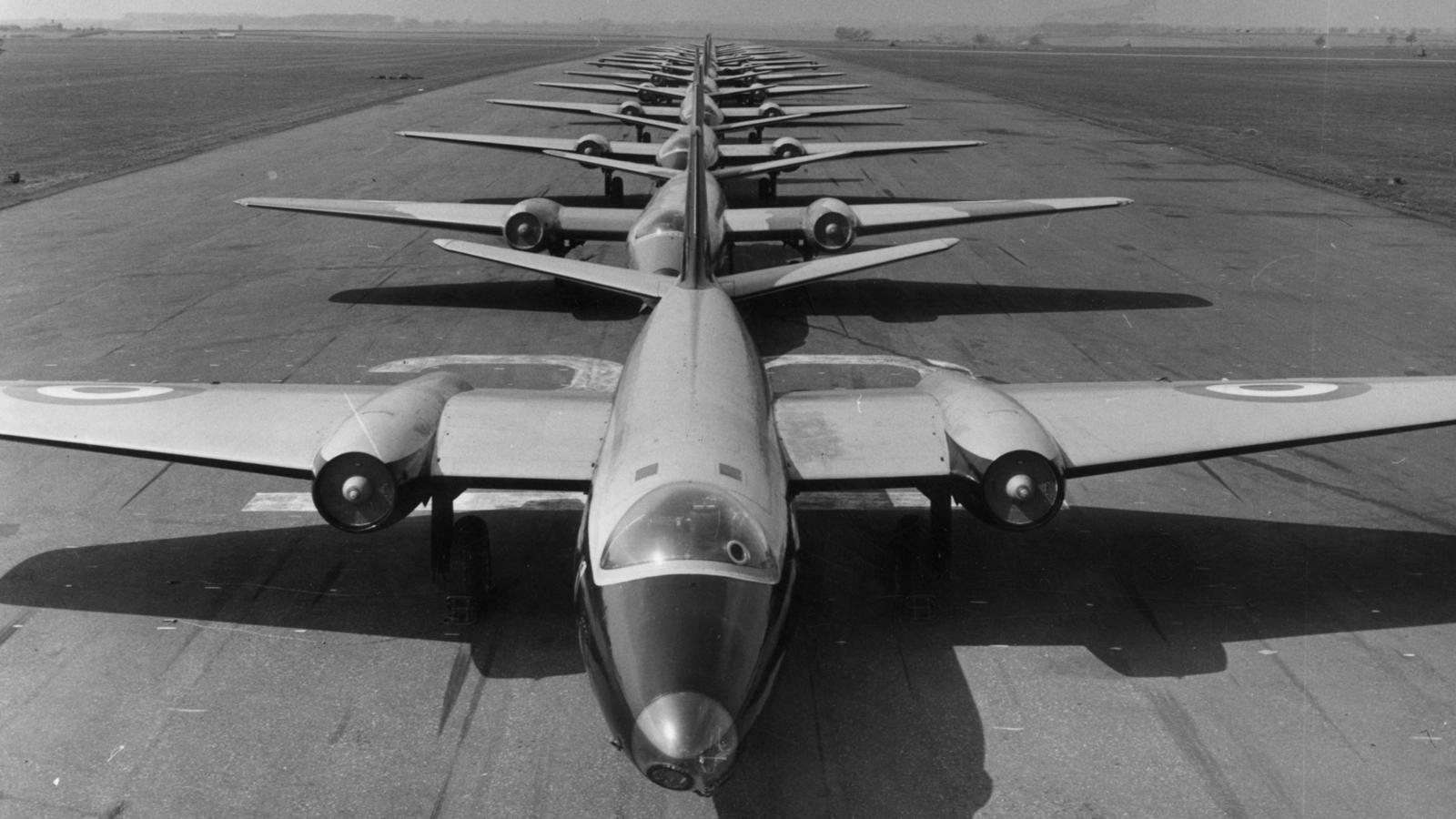
Canberras were designed as bomber aircraft, but the design proved useful for other roles (Credit: Getty Images)
The Canberras used by Nasa are an American version, designated WB-57, and based on the B-57 model built under licence by aircraft-maker Martin in the 1950s; they constructed some 400 between 1953 and 1957. Nasa’s examples are the very last still on active service – some 33 years after the US Air Force retired theirs. Recently, the three remaining Canberras were pictured flying in formation over Houston, where they are based.
Nasa’s Canberras are a part of the agency’s Airborne Science Program (ASP), explains Charles Mallini, who is the program manager for Nasa’s Canberra fleet. “The ASP is responsible for providing aircraft systems that further science and advance the use of satellite data,” he says.
Their ability to fly high makes them suitable for a variety of jobs, says Mallini, many of them in support of Nasa satellites. These include calibration tests to help fine-tune measurements from satellites, test new sensors before they are launched into space, and obtain high-altitude measurements which can then be crosschecked with readings taken from satellites in orbit. The Canberras have flown a range of science instruments, measuring atmospheric chemistry, cloud particles, cosmic dust, soil moisture, sea ice elevation and more, says Mallini.
The Canberra proved to be a good design right from the very start – David Keen, RAF Museum
That Canberras are still flying is a tribute to the aircraft’s design, which is all the more impressive given that the Canberra is from the very first generation of jet aircraft – a time when aircraft designers were struggling to deal with the enormous issues that came from travelling at such high speeds. And it’s even more exceptional because the Canberras are doing a job that was undreamed of when the aircraft first entered service.
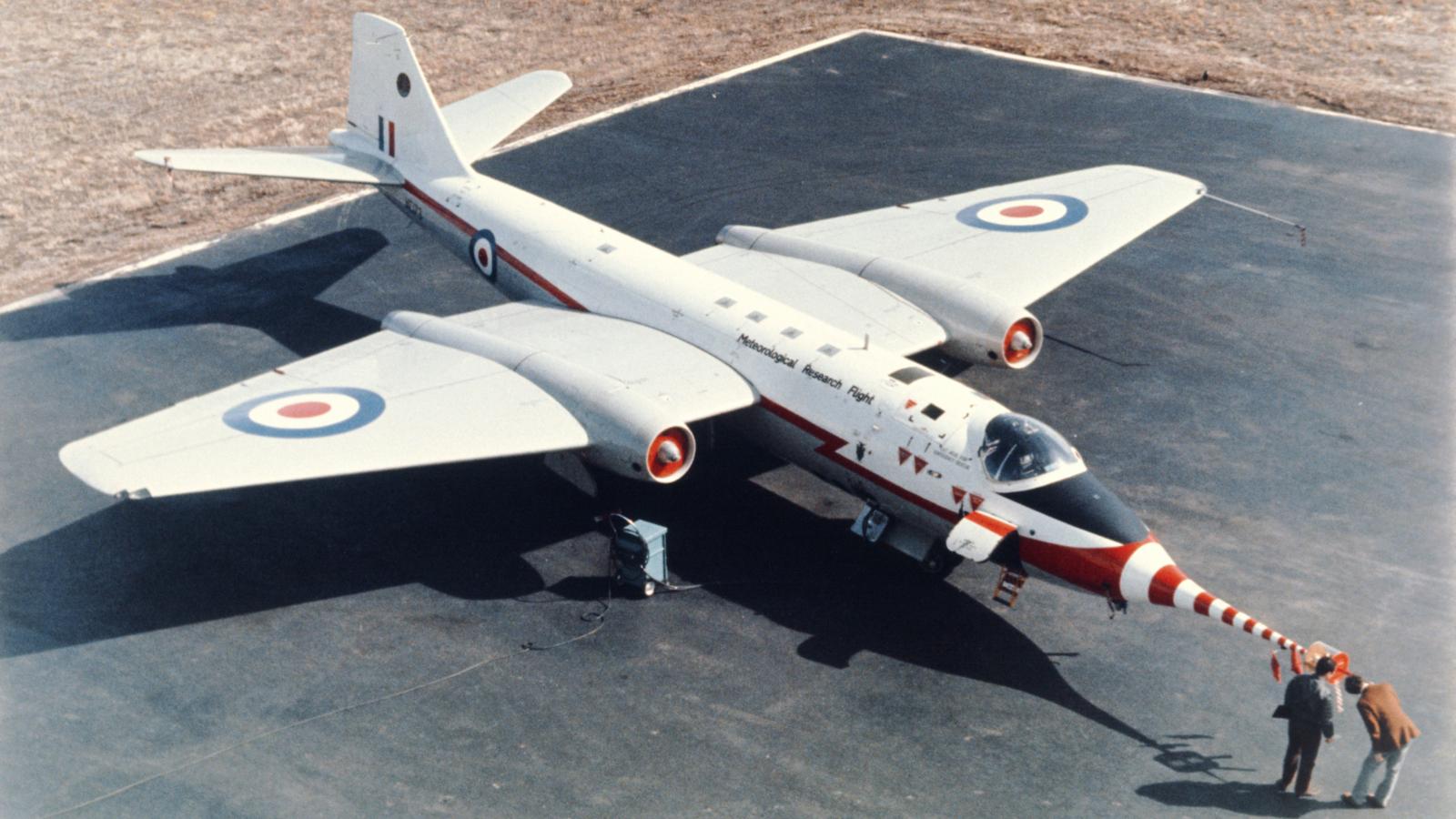
The RAF also used some Canberras for high-altitude meteorological work (Credit: Science Photo Library)
The English Electric Canberra began life with the Air Ministry’s 1944 call for a new, fast bomber, and first flew in 1950. It was a sleek and graceful design, looking very much like the fighter aircraft of the time; the pilot and navigator sat next to each other in a fighter-style cockpit, while a bomb aimer peered through the Perspex nose of the aircraft. The Rolls-Royce Avon engines, a design that would later power Britain’s supersonic Lightning fighter, were housed in aerodynamic nacelles, one on each of its thick wings. The plane’s wingspan was almost exactly as long as the aircraft’s fuselage, an oddly neat detail in an aircraft built to be fast, reliable and easy to fly. In 1957, a Canberra broke the record for highest altitude, when it reached a height of 70,310ft (21,400m).
Fast and high
“The Canberra proved to be a good design right from the very start,” says David Keen from the RAF Museum, Hendon.
“It could go quite fast for a bomber, and go higher than any other bombers could go,” he says. The Canberra didn’t carry any defensive guns like World War Two-era bombers had – it was supposed to fly so fast that enemy fighters simply wouldn’t be able to catch up.
“These characteristics are responsible for its long career in service,” says Keen. “And they also help to make it a very good reconnaissance plane.” Bombers tend to be built so they’re easy to fly and easy to keep stable – which helps when you’re trying to accurately bomb a target – and that also tends to make aircraft a good choice for reconnaissance missions.
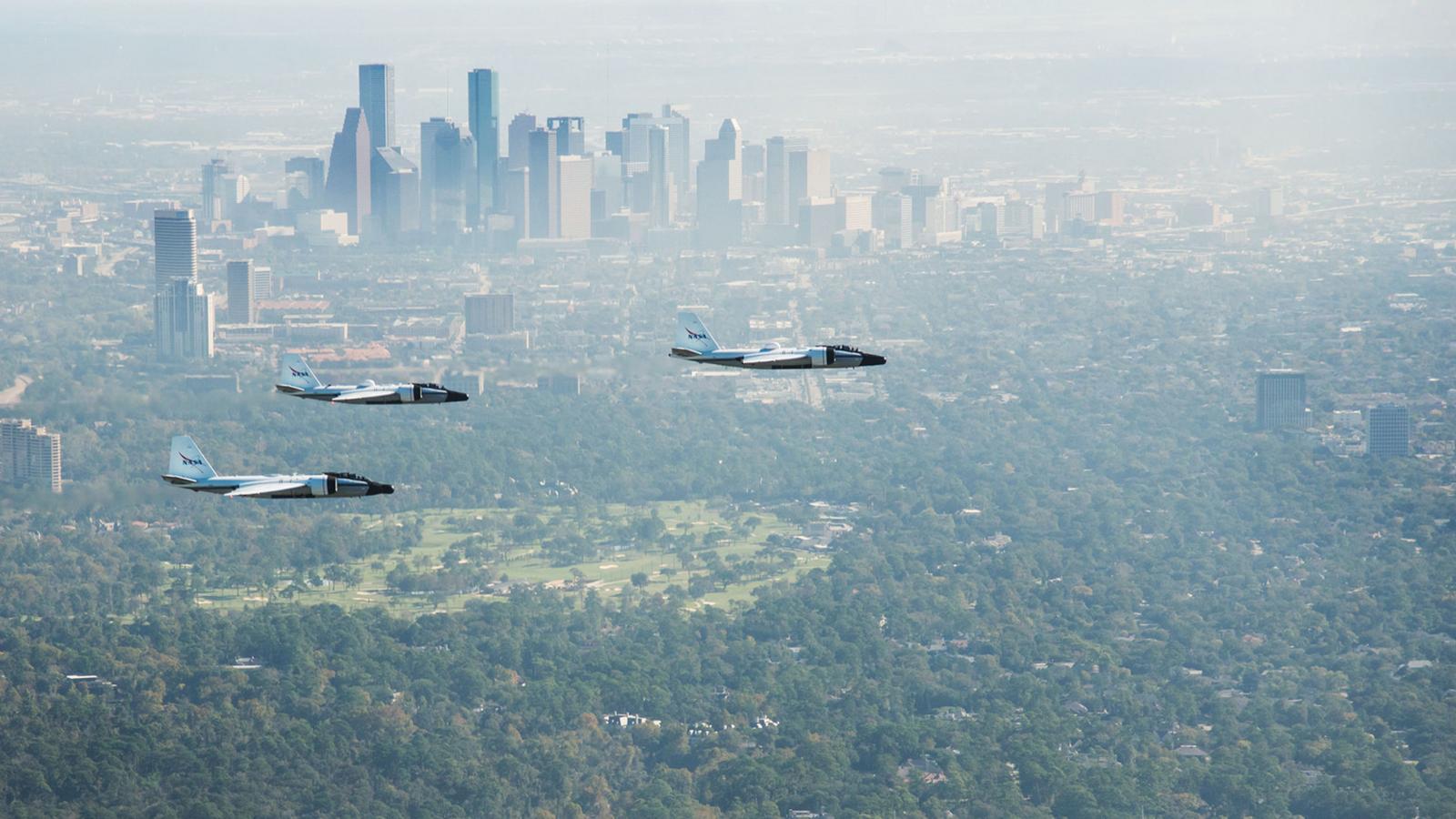
The three Canberras are only kept in the air thanks to technicians stripping spare parts off retired aircraft (Credit: Nasa/Flickr)
Early on, a Canberra could carry several high-performance cameras which could allow it to film high above enemy air defences; it also contained sensors that could listen in on electronic communications. As its combat career waned, this is the role that essentially kept the Canberra flying long past its projected life – and made it suitable for the kind of work it now carries out for Nasa.
The RAF phased out its bomber version of the Canberra in 1972, but the aircraft was to soldier on as a reconnaissance plane for another three decades. The Canberras flew high-altitude observation missions in Northern Ireland, Bosnia and Kosovo, and also were also used in Afghanistan the early 2000s, some 50 years after the first Canberras entered service.
The Canberra’s design could withstand many modifications
Former RAF wing commander David Bruce, a member of the Royal Aeronautical Society, flew in Canberras in the late 1960s, based mostly on the Mediterranean island of Malta and flying in the photo reconnaissance version. “As a navigator I loved to be able to look out and see ahead and under the aircraft whilst all the time still having the benefit of being strapped into an ejection seat,” he says.
“I think a great deal of my enjoyment of flying the Canberra was associated with the recce role – and particularly during photographic survey work for map-making purposes. During my time on the squadron we carried out surveys of the Gambia, Sierra Leone, Kenya, the Maldives and parts of UAE.
“When things were going well it handled beautifully – it had good visibility, and flying at low level demanded a lot of the pilot. Its … handling had to be very closely watched and demanded a lot of concentration and so that might add to a sense of achievement.”
Bruce flew many reconnaissance training missions at very high altitude over the Middle East, where “the contrast between the topography – the Gulf coastline, the odd huge lake, mountains of all shapes and sizes and differing colours and the sheer isolation of many villages – all were exposed in great relief.”
Soldiering on
Nasa’s Canberras are carrying out similar work to the kind Bruce did, though the aircraft themselves look somewhat different, a testament that the Canberra’s design could withstand many modifications. The wings of the blue-and-white painted Nasa examples are almost twice as long as those on the original aircraft, which help keep the aircraft aloft in the thin air at high altitudes.
The Canberras are so good at their job that there is no plan to retire them
“What makes this aircraft stand the test of time is its unique capabilities of aircraft ceiling, range, max payload and aircrew,” says Mallini. The ER-2s (based on the U-2 spyplane) that Nasa also uses may be able to fly higher, but they can’t carry as much equipment as the Canberra. Nasa’s Global Hawks, meanwhile, can fly for four times longer but can only a quarter of the payload.
The Canberras are so good at their job that there is no plan to retire them. “In fact, we are always looking at ways to increase their capabilities from the standpoint of endurance, communications systems, and data acquisition. All three aircraft have recently completed a set of upgrades which include a new autopilot system, updated ejection seat system, new data acquisition system, satellite communications, and upgraded communications system,” says Mallini. In fact, as recently as 2013 there were only two Nasa Canberras – until Mallini’s unit brought one back from retirement. The plane, known as 63-13295, had been retired since 1972; it spent some 20 years in the famous Arizona Boneyard on the outskirts of Tucson before Nasa decided there was enough work to warrant a third aircraft. When the plane – now known as Nasa 927 – carried out its first test flight in August 2013, it was the first time it had flown in 41 years.
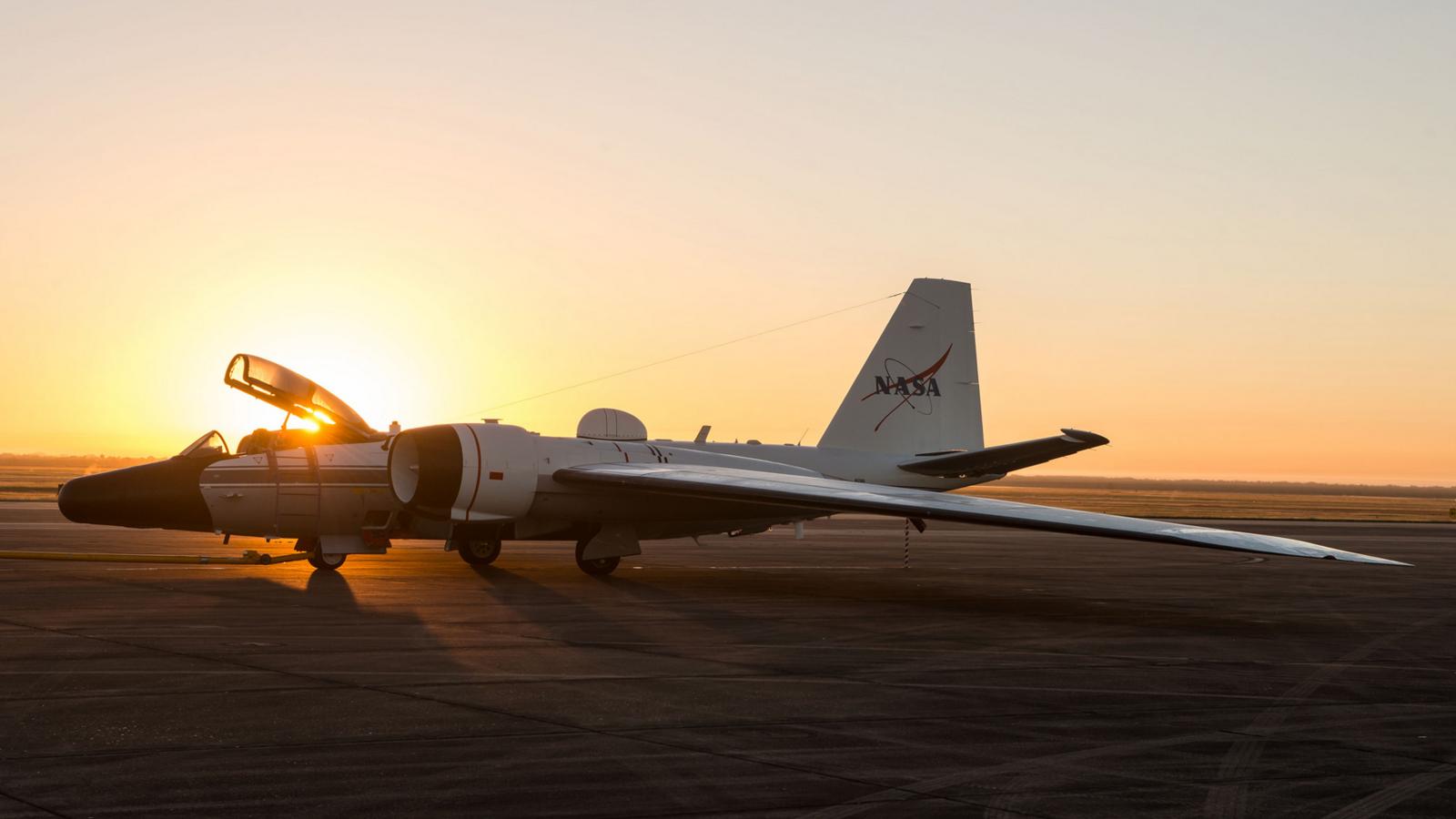
Nasa has no plans to retire its three WB-57s (Credit: Nasa/Flickr)
Keeping this fleet of old aircraft in the air, however, is not easy. “Parts acquisition is one of our biggest challenges since many of the parts on the aircraft are no longer available and the vendor has long since shut down,” says Mallini.
“We have scavenged parts from the aircraft that have been stored at Davis-Monthan Air Force Base outside of Tucson, Arizona and even from museum aircraft from around the country. When parts are no longer available our engineering team has to design or procure a functionally similar replacement part or back engineer the part. This can easily present a number of design challenges for the team.”The fuel tanks caps, for example, had been taken on and off so many times that they no longer fitted tightly “allowing the caps to come loose in flight”, says Mallini. The problem is, the company that had made them had long-since closed down. The support crew had to reverse engineer a replacement, make an engineering prototype and then make 100 new examples.
In RAF service, the Canberra’s work is now largely done by Tornado bombers and unmanned aircraft. Their retirement brought to an end one of the golden eras of aviation, one that can seem unimaginably low-tech by modern standards.
“The Canberra had a wooden tail,” Keen says. “So that meant that the RAF had to have carpenters right up until the aircraft came out of service.” From such humble beginnings, a Nasa legend has been made.
Join 500,000+ Future fans by liking us on Facebook, or follow us on Twitter, Google+, LinkedIn and Instagram. This story is a part of BBC Britain – a series focused on exploring this extraordinary island, one story at a time. Readers outside of the UK can see every BBC Britain story by heading to the Britain homepage; you also can see our latest stories by following us on Facebook and Twitter.
If you liked this story, sign up for the weekly bbc.com features newsletter, called “If You Only Read 6 Things This Week”. A handpicked selection of stories from BBC Future, Earth, Culture, Capital, Travel and Autos, delivered to your inbox every Friday.
Related Stories

The greatest test pilot in history?

Are these weird clouds ‘sonic booms’?

The Nazis’ futuristic 'flying wing'

How a Cold War bomber flew again

The plane that can fly backwards
Follow BBC Future
Copyright © 2016 BBC. The BBC is not responsible for the content of external sites. Read about our approach to external linking.
Wednesday, February 24, 2016
Monday, February 22, 2016
Drone users face jail time, fines if they don't register
Drone users face jail time, fines if they don't register
522
51

Getty Images
By Keith Laing - 02/22/16 02:48 PM EST
Drone users are facing the possibility of fines up to $27,500 and even jail time if they have not registered their devices with the federal government.
The Federal Aviation Administration's Feb. 19 deadline for drone registrations, which was set in December, has now passed.
The agency says "failure to register an aircraft may result in regulatory and criminal sanctions."
"The FAA may assess civil penalties up to $27,500," the FAA said in a frequently asked questions post on its website. "Criminal penalties include fines of up to $250,000 and/or imprisonment for up to three years."
The FAA is imposing a $5 fee for registrations, over the objections of drone advocates, but the agency provided refunds people who registered their drones within the first 30 days of the new requirement.
The agency said Monday that 368,472 drones were registered by midnight on Feb. 19, surpassing the number of airplanes that are on record with the federal government.
FAA Administrator Michael Huerta says he is encouraged by the response to the drone registration rules, which were implemented by the Transportation Department in December after an increase in the number of reported drone sightings by commercial airline pilots.
"The speed with which we were able to roll this out is a testament to the invaluable input we received from the diverse task force of stakeholders we brought together to work on this issue," he said in a recent speech at a drone policy summit in Washington.
"It’s proof that when government and industry partner, we can innovate, cut through red tape, and use technology to tackle emerging risks."
Drone users have complained about the fees, labeling them a "drone tax." A drone hobbyist in Silver Spring, Md. and a technology group have sued the FAA over the rules, arguing the mandate violates a federal law prohibiting the FAA from regulating recreational drones.
The FAA has defended the legality of the system, saying the agency has the authority to regulate all "aircrafts" that are flown in the U.S. The agency has also defended the drone registration fee is nominal.
The Hill 1625 K Street, NW Suite 900 Washington DC 20006 | 202-628-8500 tel | 202-628-8503 fax
The contents of this site are ©2016 Capitol Hill Publishing Corp., a subsidiary of News Communications, Inc.
Saturday, February 06, 2016
Wednesday, February 03, 2016
If You Registered Your Drone with the FAA, Kiss Your Privacy Goodbye
HIT & RUN BLOG
[UPDATED] If You Registered Your Drone with the FAA, Kiss Your Privacy Goodbye
Whoops! The mandatory unmanned aerial vehicle database is public and searchable.
Katherine Mangu-Ward|Feb. 3, 2016 2:28 pm
 docpop / photo on flickr
[UPDATE: CEI policy analyst and drone nerd Marc Scribner writes to note that while there are some personal drones listed in the public database, that list is of people who registered their drones under a 2012 rule governing commercial drones. Registrants under the December rules are not in there. At least not yet...]
Are you a law-abiding drone owner who registered your unmanned aerial vehicle with the federal government? Congratulations! Total strangers can now find your name, address, and lots of stuff about your fun toy in a public, searchable database!
Late last year, the Federal Aviation Administration (FAA) announced that virtually everyone who owns a drone (a drone's a drone, no matter how small, it seems) would have to register their flying computers for $5 a pop with the federal government. The penalty for failing to register: civil fines of up to $27,500 and criminal penalties of up to $250,000 and imprisonment for three years.
Reason's Scott Shackford has written about the failure of the FAA to actually convince most people to register theirdrones.
And thank goodness for that incompetence, since it will offset this latest revelation of incompetence: The 300,000 entries in the federal UAV registry are public, searchable, and downloadable, despite claims by the feds to the contrary, Engadget reports.
Go ahead, search vehicle registrations in your neighborhood right here on this handy official webpage!
This registry includes private planes as well, but scan for "UAVs under 55 lbs" to see drones that have been registered under the new law.
What's more, as the think tank Heritage notes in a report released yesterday, the FAA registry fails to accomplish its stated goals of improving safety, providing accountability, and offering education to drone owners.
"It is clear that this regulatory response was rushed and arbitrary," conclude authors Jason Snead and John-Michael Seibler, "but there is also a pernicious side effect to this purposeless regulation: Otherwise innocent people are now exposed to criminal liability for no valid purpose."
Add to that list that innocent people have now had their privacy undermined as well.
Katherine Mangu-Ward is managing editor of Reason.
Follow Katherine Mangu-Ward on Twitter
VIEW COMMENTS (29) | LEAVE A COMMENT
You must have an account and be logged in to comment.
Click here to register, or here to login if you already have an account
©2015 Reason Foundation.|reason.org |privacy policy|terms of use|technical feedback
Monday, February 01, 2016
Sunday, January 31, 2016
Saturday, January 30, 2016
Boeing B-52F Stratofortress - "Fuel Starvation & Bail-Out" - 3/14/61
Tuesday, January 26, 2016
Saturday, January 23, 2016
Friday, January 22, 2016
Wednesday, January 20, 2016
Tuesday, January 19, 2016
Monday, January 18, 2016
Airbus A380 landing in a heavy crosswind at Düsseldorf airport in Germany
This incredible video shows a massive Airbus A380 landing in a heavy crosswind at Düsseldorf airport in Germany
Posted by NBC Nightly News with Lester Holt on Tuesday, September 29, 2015
Monday, January 04, 2016
RUSSIAN COLD WAR AVIATION VIDEO
Mighty Su-15 InterceptorIconic Soviet Interceptors Su-15 Flagons, Tu-128 and Su-11
Posted by Cold War Soviet Aircraft on Sunday, January 3, 2016
Saturday, January 02, 2016
Tuesday, December 29, 2015
Saturday, December 26, 2015
Air Fete 1992 Air Show
Air Fete 1992.Raf Mildenhall 1992 filmed from ( Johns field ) .
Posted by Jetnoiseforever on Friday, October 23, 2015
F-4 Phantom Action
A wish i was there NOW moment.when the phantom was king of A.C.M.I filmed in hi8
Posted by Jetnoiseforever on Tuesday, December 22, 2015
Wednesday, December 23, 2015
100 Years of Commercial Aviation
One year ago today I uploaded this video, which honors 100 years of commercial aviation. I think it still is a very powerful video, and if you haven't seen it yet, give it a view, there are a few fun surprises in their. Can you name all the planes?- N899GS | Co-FounderYoutube Mirror: https://www.youtube.com/watch?v=w2-DycqlpkQ
Posted by World of Aviation on Monday, June 8, 2015
UPS Boeing 767 Bad Landing LAX
UPS Boeing 767-300ERF slamming it down at LAX! Notice how the rear part bounces off the runway! This could have ended really bad, luckily the front gear managed to stay put! - Captain K, Co-Founder
Posted by World of Aviation on Wednesday, December 23, 2015
Tuesday, December 22, 2015
AWESOME DC-6 LANDING - MUST TO SEE
AWESOME DC-6 LANDING - MUST TO SEE
Increíble Douglas DC-6 aterrizando en tierra :O :O :O www.facebook.com/wannaflypage (Y)
Posted by wannafly on Saturday, March 28, 2015
Monday, December 21, 2015
Insane Future Weapon Concepts
Insane Military Concepts - Stealth Anti-Tank/Bomb podsThe future is a dangerous place indeed! 2mins 40s is insane
Posted by The Forces Feed on Thursday, December 10, 2015

Wednesday, December 16, 2015
Monday, November 30, 2015
Amazon unveils new Prime Air drone prototypes

Amazon unveils new Prime Air drone prototypes
 Brett Molina, USA TODAY11:09 p.m. EST November 29, 2015
(Photo: Amazon)
1223CONNECTTWEET 114LINKEDIN 50COMMENTEMAILMORE
Amazon revealed the latest prototype of drones it will deploy as part of its Prime Air service using the unmanned aerial devices to deliver packages in under 30 minutes.
According to details released Sunday by the online retailing giant, Amazon says the drones weigh 55 pounds and can carry packages weighing up to 5 pounds. The drones fly under 400 feet and use "sense and avoid" technology to dodge potential obstacles en route to its delivery destination.
"We are testing many different vehicle designs and delivery mechanisms to discover how best to deliver packages in a variety of environments," reads a statement from Amazon. "We have more than a dozen prototypes that we’ve developed in our research and development labs. The look and characteristics of the vehicles will evolve over time."
A video released by Amazon shows the drone scanning an area near the delivery address to find a landing spot, followed by a hatch opening from the bottom to drop the package. Amazon says they are testing drones in "multiple international locations."
The company says the service will launch once the company has "the regulatory support needed to safely realize our vision."
In March, the Federal Aviation Administration granted Amazon approval to fly drones for research into the Prime Air service after first revealing plans to work with drones for deliveries two years ago.
Other companies are also exploring drones as a new method of package delivery. Earlier this month, Walmart sought permission from the FAA to start drone testing,while Google reportedly revealed during an air traffic control convention in Washington, D.C., that it wants to launch a drone service in 2017.
Follow Brett Molina on Twitter: @brettmolina23.
1223CONNECTTWEET 114LINKEDIN 50COMMENTEMAILMORE
Saturday, November 28, 2015
Toddler loses eye after drone propeller sliced through it
Saturday 28 November 2015 | UK News feed
Toddler loses eye after drone propeller sliced through it
An 18-month-old boy was left blind in one eye when an out-of-control drone hit him in the face

Oscar Webb with his mum, Amy Roberts Photo: BBC

By Eleanor Steafel
12:42PM GMT 28 Nov 2015
An 18-month-old boy lost his left eye when he was hit in the face by an out-of-control drone.
Oscar Webb was left blind in one eye when a propeller sliced through his eyeball while he was playing in the garden.
Doctors fought desperately to save Oscar's eye but they were forced to remove it as the damage was too severe.
Speaking on Watchdog on Thursday, Oscar's mother told of the moment she realised how bad the accident had been, as she raced to hospital with her son.

Amy Roberts, from Stourport-on-Severn, Worcestershire, said: "What I saw, I can still see it now, it was the bottom half of his eye and it's the worst thing I've ever seen.
"I just hoped and prayed all the way there that what I saw wasn't true and wasn't real.
"I can't really even remember what I was thinking at the time. I just remember waiting for someone to come and say it was OK.
"They (the doctors) did say that it was one of the worst eye incidents they'd seen. It was hard, I cried that much that even the consultant, it brought tears to her face."
Surgeons performed several emergency operations to try to save Oscar's eye but the drone had damaged it beyond repair and Oscar now faces having a series of further operations before he can have a prosthetic eye fitted.
The accident, which happened seven weeks ago, occurred when a drone being flown by family friend Simon Evans spiralled out of control.

Mr Evans, who was an experienced drone operator before the accident, described the moment it hit Oscar.
He said: "It was up for about 60 seconds. As I brought it back down to land it just clipped the tree and span round.
"The next thing I know I've just heard my friend shriek and say 'Oh God no' and I turned around and just saw blood and his baby on the floor crying."
Mr Evans said he has not flown the gadget since the accident as the sight of one makes him feel "physically sick".
Oscar's mother said she wanted to warn others how dangerous drones can be.
"You don't realise the dangers, you don't expect something so severe to happen from what people call toys, I wouldn't class them as toys," she said.
Oscar's grandmother, Anita Roberts, who contacted the BBC after seeing a programme about the devices said it had been very upsetting.
"You can't take it in, the shock of it all, it's too much really," she said.
"You wish you could have been there instead of him, he's a baby."
The Civil Aviation Authority has released guidelines for how to fly drones safely and there will be a public consultation before a government strategy is published in 2016.
© Copyright of Telegraph Media Group Limited 2015
Sunday, November 22, 2015
Saturday, August 22, 2015
Monday, August 03, 2015
Challenger, Columbia wreckage on public display for 1st time
Get today's electronic OEM design headlines and news - Sign up now!
 This Tuesday, July 21, 2015 photo shows a side body panel of space shuttle Challenger, left, and the cockpit widows of Columbia, right, displayed at the Forever Remembered exhibit and memorial for the astronauts that perished on the two shuttles at the Kennedy Space Center Visitor Complex, in Cape Canaveral, Fla. (AP Photo/John Raoux)CAPE CANAVERAL, Fla. (AP) — NASA is offering up wreckage from the Challenger and Columbia for public view after hiding it from the world for decades.
A new exhibit at Kennedy Space Center features two pieces of debris, one from each lost shuttle, as well as poignant, personal reminders of the 14 astronauts killed in flight.
It is an unprecedented collection of artifacts — the first time, in fact, that any Challenger or Columbia remains have been openly displayed.
NASA's intent is to show how the astronauts lived, rather than how they died. As such, there are no pictures in the "Forever Remembered" exhibit of Challenger breaking apart in the Florida sky nearly 30 years ago or Columbia debris raining down on Texas 12 years ago.
Since the tragic re-entry, Columbia's scorched remains have been stashed in off-limits offices at the space center. But NASA had to pry open the underground tomb housing Challenger's pieces — a pair of abandoned missile silos at neighboring Cape Canaveral Air Force Station — to retrieve the section of fuselage now on display.
The exhumation was conducted in secrecy. Everything about the exhibit, in fact, was kept hush-hush during the four years it took to complete the project, out of respect to the dead astronauts' families.
June Scobee Rodgers had never seen an actual remnant of her husband's destroyed shuttle, Challenger, until previewing the exhibit just before its low-key opening at the end of June.
Displayed in a dimly lit room: a 12-foot section of the left side body panel of Challenger, standing vertically and bearing the gouged and scraped but still brilliantly colorful U.S. flag, and the charred frames for Columbia's cockpit windows, seemingly floating at eye level.
"Sad, yes," to see the wreckage but it is "a wonderful memorial" to the shuttles, Scobee Rodgers said. The items representing the astronauts, on the other hand, are a "truly fitting" reminder of who they were as individuals.
Challenger commander Francis "Dick" Scobee's display case, on the left side of the exhibit's main corridor, contains the leather helmet from the Starduster biplane he and June used to fly, and his blue "TFNG" T-shirt from the Astronaut Class of 1978, nicknamed the Thirty-Five New Guys.
Across the hall on the right are Columbia commander Rick Husband's scuffed cowboy boots and well-worn Bible opened to Proverbs. There's a display case for each astronaut, filled with personal items, although not all families contributed, including schoolteacher Christa McAuliffe's.
"Forever Remembered" is a permanent exhibit, part of a larger display centered on the retired space shuttle Atlantis. NASA opted to keep Atlantis at Kennedy, the shuttle launch site, after Atlantis closed the program with the final mission in 2011.
The entrance to the new exhibit is directly beneath the nose of Atlantis, which is suspended with its payload bay doors wide open as though perpetually orbiting Earth.
One recent afternoon in July, tourists filled the predominantly blue hallway, pausing in front of the astronaut display cases. One woman wondered aloud which shuttle burned up and which one blew up. A few young children scampered about, their parents shushing them given the solemnity of the place.
A few weeks after visiting the exhibit, Scobee Rodgers noted in a phone interview that much of the world's population wasn't even born yet when Challenger went down in 1986.
"It's mostly history for the general public. It's very personal for us," she said.
Amber DiSalvatore — an Apopka, Florida, resident touring the space center with her husband and two children — was 4 years old at the time of Challenger. Seeing the actual wreckage — along with Husband's Bible — brought tears to her eyes.
The astronauts sacrificed their lives for exploration, said DiSalvatore, "so it's something that everybody — every human being — should know."
In the aftermath of the Feb. 1, 2003, Columbia accident, NASA meticulously stored the 42 tons of debris in Kennedy's iconic Vehicle Assembly Building and made them available for research. The space agency displayed a remnant or two of Columbia in a restricted area of the space center and, for the fifth anniversary, organized a traveling in-house exhibit. The relics were intended as safety reminders for the workforce. The three surviving shuttles — Discovery, Atlantis and Endeavour, Challenger's replacement — still were flying then.
After Challenger's accident, NASA wanted it out of sight and out of mind. The Jan. 28, 1986, launch disaster unfolded on live TV before countless schoolchildren eager to see an everyday teacher rocketing toward space. And so Challenger's wreckage — all 118 tons of it, salvaged from the Atlantic — was buried in the pair of former missile silos, 90 feet deep.
The chamber containing this particular fuselage section, in fact, had never been opened — until the "Forever Remembered" exhibit began to take shape.
Determined to avoid any hint of commercialism or sensationalism, NASA took charge of the memorial effort at the visitor complex, which is run by an outside company. The job fell to Michael Ciannilli, a shuttle engineer and test director who had become responsible for the Challenger and Columbia debris.
"Our biggest concern the whole time was doing the right thing," Ciannilli said. "Is this the right time? Is this the right thing?"
As the conversations unfolded over the months then years, Ciannilli entered the underground storage silos to find the proper display piece to represent Challenger.
"I was hoping to find something that would show the beauty of Challenger, the dignity of Challenger, the strength of Challenger, and these are words I don't use lightly," Ciannilli said.
The 12-foot section of fuselage with the flag fit the bill. For Columbia, he chose the cockpit window frames. He said it's like gazing into the eyes of Columbia and thus its soul.
Ciannilli tapped the same preservation company that had worked on the Titanic, for the Challenger and Columbia relics. He sought out soothing, uplifting music for the exhibit.
And, yes, he deliberately kept out real-time scenes of the shuttles disintegrating.
"There's more to this story" than those awful final moments, he said. "Great pains were taken not to have anything sensationalized or exploited."
Above all else, Ciannilli wanted the end result to be respectful.
"I can't stop thinking about it," Evelyn Husband-Thompson, the widow of Columbia's commander, confided in a NASA interview. "As you walk in, you know that you're in a special place."
Wednesday, July 29, 2015
Monday, July 27, 2015
Tuesday, July 21, 2015
A drone is going to bring down an airliner: why are we waiting for that to happen?
Home > Blogs > ATW Editor's Blog > A drone is going to bring down an airliner: why are we waiting for that to happen?

A drone is going to bring down an airliner: why are we waiting for that to happen?
Jul 21, 2015 by Karen Walker in ATW Editor's Blog RSS
Sooner or later – and I personally believe it will be sooner – an airliner full of passengers and crew is going to be brought down after colliding with a drone.
There – I’ve said it, though most in the industry won’t. That’s understandable, but it’s still not right.
We must have an urgent, honest discussion about what is happening in the skies today. Even more urgent, we must do something about the rapidly escalating danger that drones – unmanned aerial vehicles – pose to commercial air transport.
If further evidence of the critical situation were needed, look at what happened yesterday close to Warsaw airport. A Lufthansa Embraer E-195 with 108 passengers aboard narrowly missed a collision with a so-far unidentified drone. We now sit just 330 feet away from a different story entirely – one that would have been an instant global newsflash and would have dominated the headlines for weeks; “Airliner brought down by drone: at least 100 dead”.
That’s not hyperbole. It’s true. This incident, which follows an alarming increase in the number of reported near-misses between airliners and drones close to major commercial airports – requires immediate attention. I would argue the issue of drone oversight and control should take priority over airliner tracking (post MH370’s disappearance), military/intelligence agency communications with commercial air transport authorities (post MH17’s missile shootdown), and psychological monitoring of pilots (post Germanwings 9525 crash). Why? Because the threat to airliners from drones is more likely and more imminent than the scenarios that led to any of these tragedies.
If (when) an airliner is brought down by a drone, there will be outrage, there will be calls for immediate action, there will be task forces, there will be finger-pointing, and there will be hundreds – likely thousands – of reported near-miss incidents to point to. There will be new legislation restricting the use of drones near airports, requiring drone users to be registered, certified, and take some level of training. And there will be stiff penalties for non-compliance. My question is, why are we waiting?
Regulating and monitoring drone use, especially small UAVs, is not easy and won’t be cheap. But that’s the case with most safety practices in commercial air transportation. It won’t be popular with drone enthusiasts and the UAV industry. But popularity surely does not trump an industry that will be responsible for safeguarding almost 4 billion passengers by 2017 and which generates trillions of dollars of economic benefits to countries everywhere?
So why aren’t we – by which I mean FAA, ICAO, IATA, aircraft manufacturers, the airlines, law enforcement agencies and governments everywhere - not making UAV regulation and control their top priority?
I have an awful suspicion, and one best illustrated by comparing the drone threat to that of the German threat in World War II. Germany had its Enigma encryption machine for encoding and communicating top-secret messages. Famously, British cryptologists created a machine that cracked the Enigma code and allowed intelligence services to read those German communications and hence know about planned strikes. But they often didn’t act on that knowledge because to do so would have given away the fact that they had cracked Enigma, potentially extending the war if Germany then changed the code. The costs of an extended war were deemed higher than those of individual losses, such as planned allied city bombings or warship strikes, which were known about thanks to the decryption machine but could not be acted upon.
With today’s UAV problem, as complex and expensive as it will be to resolve, I wonder whether another cost calculation is being considered? Getting sufficient funds, resources and commitment to implement an effective, global drone-control regime in place will be very challenging and likely a slow process. Unless. Unless an airliner, let’s say a western airliner with some 300 people onboard, is brought down by a drone. Whether that act by the UAV operator is unintended or deliberate, the game changes overnight and the path to drone regulation and legislation becomes much easier to fund and implement. Three hundred lives is a very high cost, but perhaps worth the greater good of thousands of lives saved by an expedited UAV-control system?
I don’t want to wait for the “enigma solution”. The question is, what are we going to do about it?
Wednesday, July 15, 2015
Friday, June 19, 2015
Boeing Ditches Drag Reduction System For 777X
Production Rates: Are Airbus And Boeing Aiming Too High?
Airbus and Boeing need to increase output of narrowbody jets to burn off massive backlogs, but lofty production rates the two airframers are talking about probably cannot be sustained over the long run, says the CEO of GKN Aerospace.
FULL ARTICLE
Boeing Ditches Drag Reduction System For 777X
Boeing has decided to drop the hybrid laminar flow control drag reduction system from the 777X and may even review its future use on the stretched 787 derivatives.
FULL ARTICLE
Mitsubishi Evaluates Further MRJ Stretch
Mitsubishi Aircraft Corporation is conducting market research to evaluate the feasibility of a longer stretch of the Mitsubishi Regional Jet.
FULL ARTICLE
Airbus Relaunches A320/321 PTF Conversion
Airbus is teaming up with Singapore-based MRO provider ST Aerospace and Elbe Flugzeugwerke to give the passenger-to-freighter conversion of its A320/A321 aircraft a second try.
FULL ARTICLE
Interest In Scorpion Picks Up
Textron AirLand’s $20 million Scorpion Light Attack Armed Reconnaissance gains momentum with possible landing of a launch customer.
FULL ARTICLE
MBDA Could Deliver Weapon To Destroy Small UAVs By End Of Decade
The next step in MBDA’s development of a practical laser weapon, with a power output as high as 120 kW, is to develop a “deployable” demonstrator.
FULL ARTICLE
See what's flying in the air over Le Bourget at the Paris air show.
Watch video
Video: Business Jets At The Paris Air Show
Speed is all what business aviation is all about, and the Paris air show is an important venue for business jet makers to display their long-range aircraft. Fred George takes a look at the aircraft on display at Le Bourget, including Dassault’s new Falcon 8X which is making its air show debut.
Watch video
Video: Thi
View Web Version
AVIATION WEEK NETWORK


Sunday, June 14, 2015
U.S. Navy Blue Angels
Video from the Slot position during the Diamond Half Squirrel Cage maneuver on take-off. Like the video??? Please share and like the page!
Posted by U.S. Navy Blue Angels on Saturday, June 6, 2015